Tray Dance Behabak
|
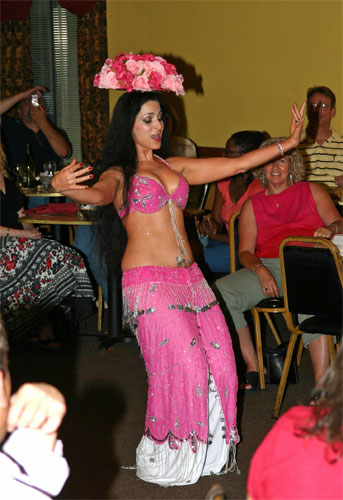
This soft, flowing & modern belly dance was choreographed by Schadia to a
sweet song called "Behabak," which means "I love you" in Arabic. This
choreography engages both the dancer and the audience with the graceful
incorporation of balancing a tray while performing the choreography.
Raqs al Seniyaa, or dancing while balancing a tray, is a very old form of
dance most likely originating in Morocco as an interpretive dance of the
Moroccan Tea Ceremony. The Moroccan tray balancing is often done with a tea
pot on top of the tray, surrounded by tea cups w/ little candles in them.
Dancing with a tray of flowers as we will be learning to do in this course
gives our Tray Dance a modern slant and makes the dancer feel feminine and
beautiful. What women doesn't love to surrond herselves with flowers?
If you haven't balanced before, balancing a tray is a great place to start.
Trays will be available for purchase at the studio. Schadia will give you
lots of tips and tricks to make balancing a snap. And Yes, she will also go
over how to build a lovely flower arrangement to go on top of your tray.
Don't miss the rare opportunity to learn this beautiful choreography and the
graceful art of tray balancing.
Props Required: Tray
 Video (requires fast internet) Video (requires fast internet)
|
|
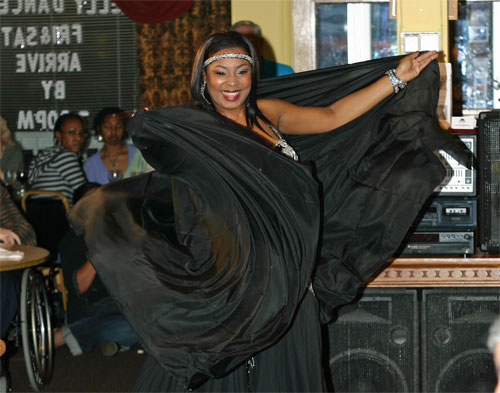
Sherihan
Sherihan is a beautiful piece of classical Egyptian music with a
choreography that is a mix of elegance, grace, folksy spunk and feminine
power. Yes! All of this is possible in one choreography, especially if you
are dancing to Sherihan! This is a dance is of the American Fantasy Genre
and was choreography by Schadia. It encorporates the use of both a silk veil
and zills.
Props: Veil and Zills
|
|
Turkish Style
The Turkish cabaret style is Schadia & Nazeem Allayl's favorite form of belly dance,
because they gives the dancers so much creative freedom. It is very high energy,
full of large movements and at the same time sexy and smoldering.
Unlike the Egyptian cabaret style of dancing, Turkish cabaret still has very,
very strong attachments to its gypsy roots. The Turkish gypsy style is earthy and powerful,
giving the feeling both in attitude and movements that women are strong, full of power and pride.
The modern Turkish cabaret style is very flamboyant and larger than life, not only in dance style,
but in costuming too.
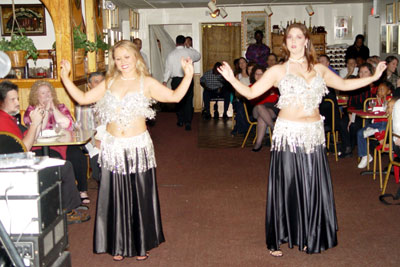
Hüp
"Hüp" is a very popular song by the Turkish heartthrob Tarkan. He sings to the woman he loves
--- pledging his love to her and appreciating her love for him.
He says that he wants her to breath him in, so that they can become one.
The style of the dance is playful & sexy.
Choreographed by Schadia
|
|
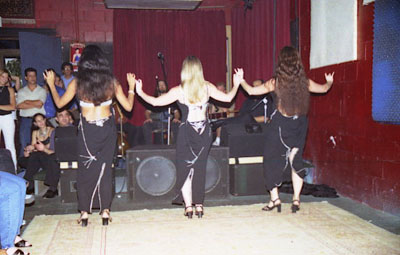
Ay!
"Ay!" is also a song about love, but in this song Tarkan talks of being totally in love with a woman,
who didn't seem to know he exists. He writes her name in the sky with thousands of stars. She laughs
and doesn't pay attention. He pierces the mountains, conquered the deserts and the seas, but still she
didn't notice him. Ah, isn't that always the way with women!
Choreographed by Schadia & members of Nazeem Allayl.
|
|
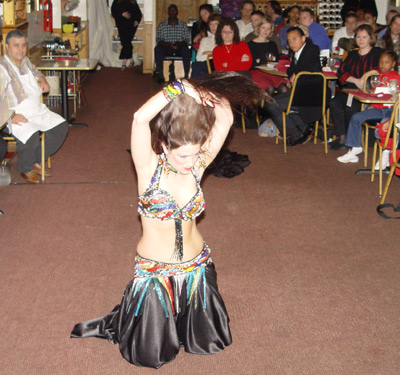
Karasin Duenyam
The song Karasin Duenyam means "Let My World Go Dark". Karasin Duenyam is quite a contra point to Ay.
It is also about a scorned love, but here, it is a woman in love with a man, who has left her.
The dance shows us a woman who is eaten up by her one sided love, with nowhere to turn to but a dance of misery.
Choreographed by Schadia
|
|
Haberi Olsun
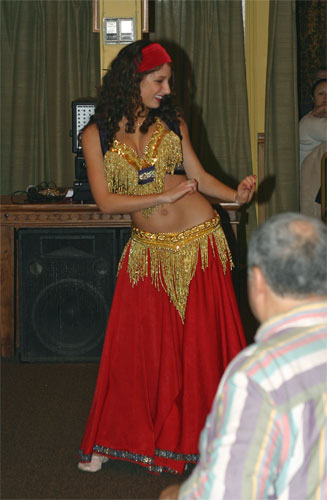
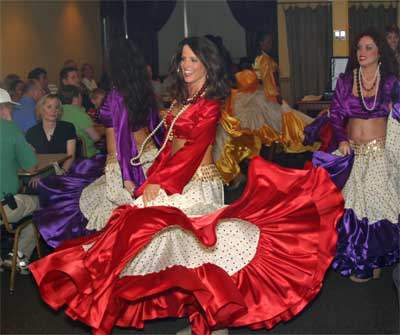
Haberi Olsun is a Turkish Karsilama choreography. It is a high energy skirt
dance modeled loosely after the Turkish romani (a.k.a. gypsies) dances, but
is not your typical romani dance, but a style that Nazeem Allayl calls
"gypsy nouveau." This choreography is definitely gypsy in heart and spirit,
but rather than using a classic Turkish romani music, Nazeem Allayl chose a
super modern 9/8 song, which was a recent number one hit on the Turkish
charts.
Choreographed by Schadia & members of Nazeem Allayl.
|
|
Egyptian Beledi styles
Since Egyptians dancers first brought belly dancing to America at the Chicago World's Fari in 1893 , the Egyptian style of belly dancing has remained the most popular and widely danced style of belly dance in America.
There are many different styles of Egyptian dance. Perhaps one of the most popular styles comes from the Ghawazee of Upper Egypt. The Ghawazee are gypsies and have always made their living playing music and dancing. The Ghawazee style of dancing is characterized by large, earthy, grounded and energetic movements.
Beledi dances often use similar moves to that of the Ghawazee. In Arabic, the word "Beledi" means "Dance of the country," hence 'Egyptian Beledi' would be the dance of the country of Egypt.
Schadia & her Dancers do not perform straight & strictly traditional folk dance, but a style called "Urban Beledi," which has glitzier costumes & mixes cabaret & folk styles.
Although the Egyptian Cabaret dancing has developed far beyond its roots, you can still see the influences of the Ghawazee & Beledi styles, as well as the influences of western dances, such as ballet. Modern Egyptian cabaret dancing is very controlled, elegant, and refined. It is done usually in a rather small space & does not include a lot of traveling or turns. Muscular control is emphasized and movements are small and internalized.
Egyptian Raks Al Assaya
Raks Al Assaya is pronounced "rocks all uh SI yuh", with the "SI" syllable rhyming with "pie".
This is the Arabic term for the cane dance. This dance originated in southern Egypt, in the region known as
the Said (Sigh eed) or Upper Egypt. Traditionally, in the Said, men carried long sticks with them, which they used
as weapons. Eventually they developed a dance in which they feigned fighting with these sticks.
Women then began dancing with canes as a way of playfully imitating this men's dance, and eventually raks al
assaya developed into a distinct women's dance. Cane dance movements therefore originate from an exhibition of skill
and prowess and accent the dancers' movements.
|
|
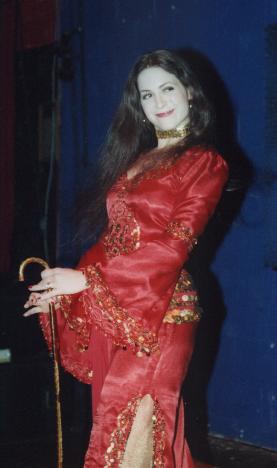
Hadil Cane Dance
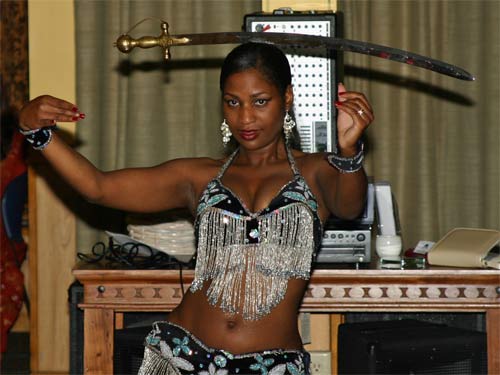
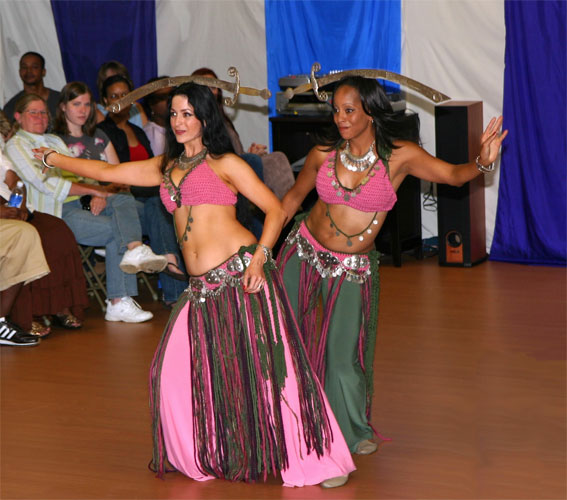
Cane Dance by Hadil is a classical egyptian cane dance. Cane dances are playful interpretations of men's stick fights and stick dances, and are often performed in beledi dresses.
Props Required: Cane
Video (requires fast internet)
|
|
Bedauia
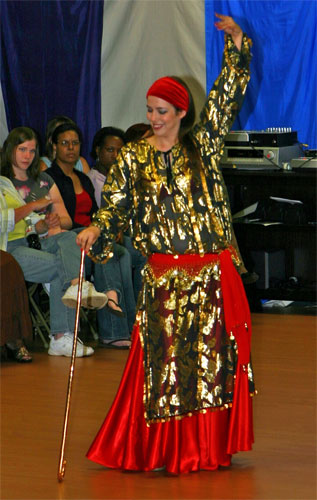
Bedauia is a Ghawazee dance choreographed by Jasemin Jahal. The Ghawazee have their origin in Upper Egypt.
The Ghawazee were always in high demand for their skills at dancing and music-making.
The Ghawazee are, in some ways, a living expression of the dancer's dream -- to live amongst the shifting sands,
and to dance every night away...for exotic costumes and rich foods, and for music that never, ever ends...
|
|
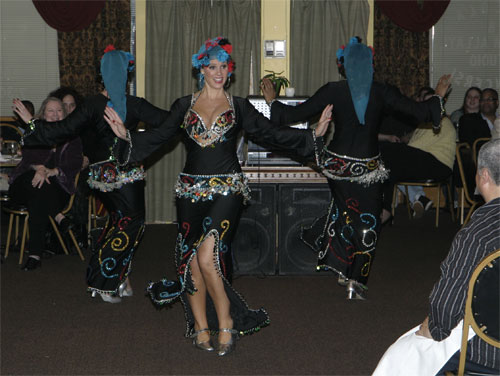
Hagallah
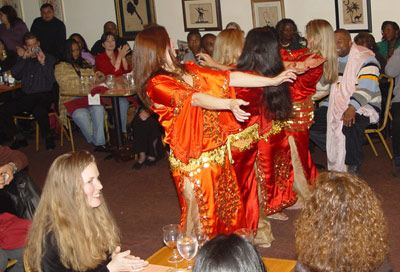
The Hagallah is an energetic traditional Egyptian folk dance. The Hagallah a
dance of celebration, usually performed by the Beduin in Western Egypt. It
is often performed during the date harvest, which also happens to be the
wedding season. The Hagallah is about women representing power and showing
their beauty as individuals. Doing Hagallah is not only fun, but a really
great work out as the entire dance has traveling 3/4 shimmies. Get ready to
shimmy, shimmy, shimmy!
Video (requires fast internet)
|
|
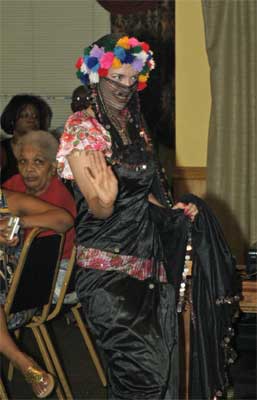
Melaya Leff
Melaya Leff is a type of character dance done by Egypt's folk troupes. It uses a shawl-type of garment known as a melaya as a prop. In the melaya leff folkloric dance, the dancer plays the role of a mischievous young woman who flirtatiously plays a "conceal and reveal" game with her wrap.
Props Required: Melaya
Video (requires fast internet)
|
|
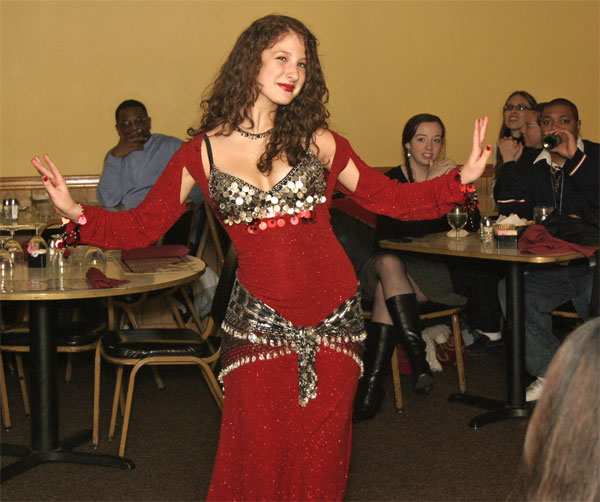
Ala Nar
This is a choreography in the old style of Egyptian Cabaret dance. In the
last half of the 20th Century Egyptian Cabaret has been highly influenced by
western forms of dance. Schadia’s dance to Ala Nar harkens back to the days,
before those western influences, when Egyptian cabaret was closer to the
folk and gypsy dances of Egypt.
The song Ala Nar, which means “On Fire!” in Arabic is a classic favorite
among Egyptians and Middle Easterners alike. It is a song about love and
being on fire with passion! Oh la la.
|
|
Egyptian-Spanish Fusion
The Egyptian-Spanish fusion genre is very popular, and it has also sprung an Egyptian-Spanish style of Belly Dance.
Spain, you ask? What does that have to do with belly dancing? Well, if you remember back to your
college history classes, you'll remember that both Spain and Portugal were occupied by the
Moores from 711 until almost 1500. The Moores spread their culture and their knowledge through
Spain and Portugal but they did so in a benevolent way. They allowed the peoples under their rule
to retain their culture as well. It is from this time in history that we still see Middle Eastern influences
on dances like Flamenco & also the Spanish influences on the dances of the Middle East.
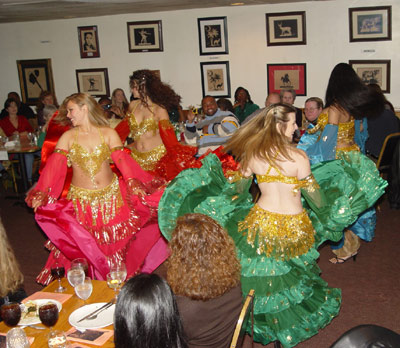
Nour el Ain
Habibi Ya Nour El Ain, which translates to "My Darling, You Are The Glow In My Eyes",
was a huge hit in 1996 by Amr Diab, not only in the Arabic world, but world wide, since
its style has a strong Spanish-Andalusian touch.
This dance was originally choreographed by Nourhan
Ole'
|
|
Ya Albi
This dance has a fusion of
many stylings including Egyptian-Spanish fusion and Turkish.
The idea behind the song was a love between two cultures separated by thousands of miles.
Written by Hakim (Egyptian), Antonio Hernandez (Mexican), and Olgui Cherino (Cuban-American),
the song shows Hakim in a vulnerable position asking his love, Olga, to come back to him.
Olga responds saying, 'I love you too, but you have to come and get me.' Kemo raps on the track,
making comments as he watches the love affair from the sidelines.
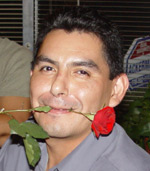
Admirer with Style
|
|
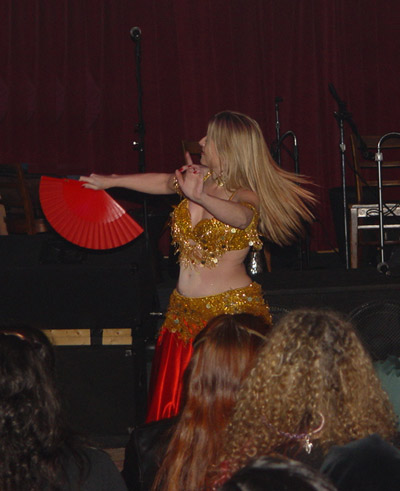
Efred
Efred was originally choreographed by Bahijah. The choreography is in the
Egyptian Cabaret style, with an undertone of American Fantasy. The feel is
much like the song itself, sweet & lovely with a bit of sass. The song
Efred, which means "Just Suppose" in Arabic, is sung by Hakim, another of
Egypt's hottest stars
Video (requires fast internet)
|
|
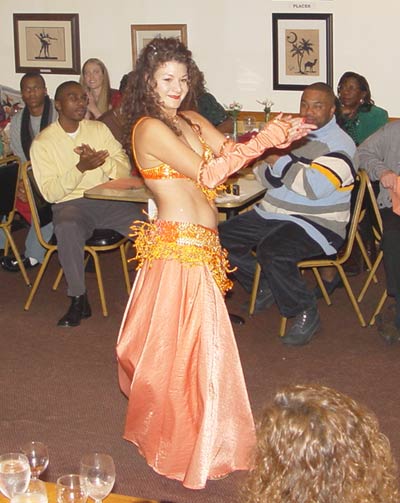
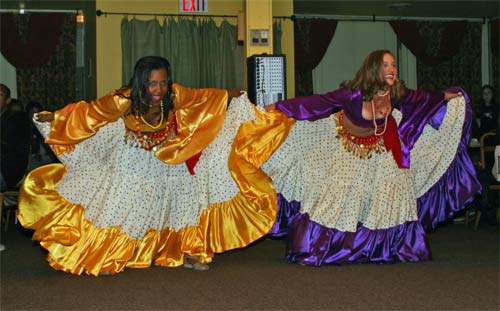
Abgal Alena
Abgal Alena is a fun and fab Gypsy Nouveau choreography by Schadia. One of
Schadia & Nazeem Allayl's signature styles, Gypsy Nouveau is influenced by
Roma/Gypsy dance moves, cabaret style bellydance, and just generally being
way too fabulous and yet folksy at the same time. This dance is fast paced,
high energy, and lots of fun to perform.
Prop: A "gypsy skirt" is required for this dance & can be purchased at the
studio.
Video (requires fast internet)
|
|
Tabla Solos
Tabla or Drum Solos are an important part of any dancer's repertoire. During solo performances with a band, a dancer will improvise moves to the beats of the drummer. It is an amazing thing to see & gives you insight into the important relationship between the dancer and her drummer.
When a live drummer is not available and/or for staged and group performances, recorded drum music is used & the dancers perform choreographed drum solo pieces. These dances are really fun to watch. They show the stamina of the dancers and their ability to live & breath the beats of the drums.
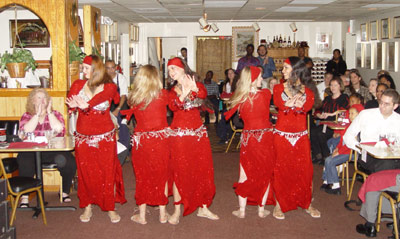
Jillina Drum
This drum
solo was originally choreographed by Jillina, but not much of the original
choreography remains. Schadia & the members of Nazeem Allayl changed the
majority of the dance to reflect her style, energy & finesse. This version
of Jillina Drum is definitely a Nazeem Allayl dance!
|
|
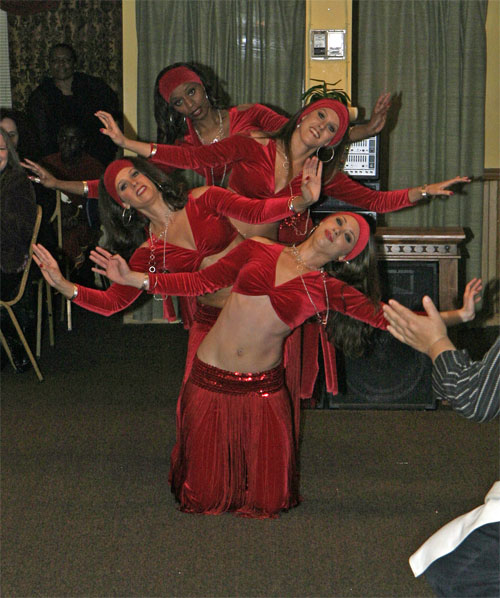
Margo Drum
This dance was choreographed by Margo Abu Odell as the sister drum solo for Irkosily. It has some of the same moves & goes beautifully with Irkosily. The choreography of this drum solo is really wonderful & it can stand on its own or go with almost any Egyptian or American Fantasy style dance. We love it!
Video (requires fast internet)
|
|
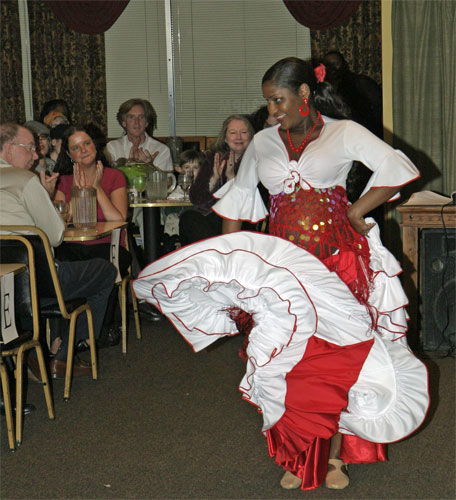
SuSu Drum
Our newest & most exciting drum solo is SuSu. It is 4 ˝ minutes of pure
adrenolin. This drum solo was choreographed by Schadia & the members of
Nazeem Allayl. It not only has the shimmies & locks traditionally found in
drum solos, but also encorporates Turkish gypsy moves, lots of spunk & a
very sassy attitude!
|
|
Aseelah Drum
Aseelah Drum is, as the name implies, a drum solo, choreographed by Aseelah.
Video (requires fast internet)
|
|
Back to Top
|
|
|